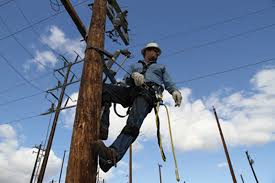
Howdy, y’all. If you’ve ever driven through a Texas thunderstorm, you’ve seen the sky light up. Now, imagine being the person who has to go out in that, climb a 40-foot pole, and get the lights back on. That’s the life of a power lineman. It’s a tough job, a proud job, and one where there are absolutely no second chances.
Out here, we have a saying: “It’s not the fall that kills you, it’s the 13,000 volts.”
That’s why the most important part of any lineman’s day isn’t climbing the pole or even fixing the line—it’s proving it’s dead first. This process is called electrical isolation, and the lineman tools we use for it aren’t just pieces of metal and plastic. They are, quite literally, our lifelines. We’re talking about Voltage Testers, Detectors, and Insulators. Without them, we’re just guessing. And guessing is the fastest way to not come home at the end of the shift.
Let’s get into the gear that keeps us safe.
The Workhorses: A Glimpse into a Lineman’s Daily Toolkit
Before we even get to isolation, you gotta understand that a lineman’s belt is heavy. We’re carrying a whole hardware store up that pole. We’ve got our basic hand tools—pliers, wrenches, and skinning knives. We’ve got our Crimpers, hefty hydraulic or battery-powered tools used to permanently join high-voltage lines together. These lineman tools are the “action” items.
But to use those tools, we first have to get up the pole. And that brings us to a key piece of gear: our climbers (or “gaffs”).
Gearing Up: The Great Climber Debate (Steel vs. Carbon Fiber vs. Titanium)
You don’t just walk up a utility pole. You climb it, using spikes strapped to your boots. And the material those spikes are attached to matters—a lot. Your legs will tell you all about it after a 12-hour storm-duty shift.
- Steel Climbers: This is the old-school classic. They’re tough as nails and relatively cheap. You can beat ’em up, drop ’em, and they’ll still get you up the pole. The downside? They’re heavy. It’s like strapping anvils to your boots. After a few hours, you feel every single ounce.
- Carbon Fiber Climbers: This is the new standard for a lot of guys. The biggest pro is the weight—or lack of it. They are incredibly lightweight, which reduces fatigue on your knees and hips. Ask any veteran lineman, and they’ll tell you that joint pain is part of the job. Carbon fiber helps delay that. The comfort is top-notch, but the cost is significantly higher.
- Titanium Climbers: This is the “Cadillac” option. You get the strength and durability of steel but at a weight that’s even lighter than some carbon fiber models. They’re built to last a lifetime. The con? The price tag. These are a serious investment, usually for the lineman who’s been in the game a while and is ready to treat their body right.
For an apprentice, steel is a great place to start. But as you build your career, investing in a lightweight carbon fiber or titanium set is one of the best things you can do for your long-term health.
“Is It Hot?” – Understanding Voltage Testers and Detectors
Okay, so we’ve climbed the pole. We’re looking at the line that’s down. Now what? You can’t see voltage. You can’t smell it. And if you feel it, it’s too late.
This is where our Voltage Testers and Detectors come in. This answers the big question: What tool is used to check electrical voltage? The answer is a family of tools, each with a specific job.
The Three Main Types of Testers
When we talk about checking for juice, we’re generally looking at three main categories.
- Non-Contact Voltage Testers (NCVTs)
- You’ve probably seen the little “pen testers” an electrician uses. They chirp or light up when you get near a live wire. Linemen use a much more robust version, often on the end of a long stick. We call ’em “tickers” or “sniffers.”
- Pros: They’re fast and keep you at a distance. You don’t have to physically touch the conductor.
- Cons: These are not for proving a line is dead. Never. They can sometimes pick up “ghost” voltages from nearby live lines, or worse, they can fail to detect voltage on shielded or insulated cable. They’re a good “first-check” to see if something is probably live, but that’s it.
- Digital Multimeters (DMMs)
- This is the electrician’s all-in-one tool. It gives you a precise digital reading of volts, amps, and ohms.
- Pros: Extremely accurate. It can tell you if you have 120 volts, 240 volts, or just a tiny bit of induced voltage.
- Cons: They require you to make direct, metal-on-metal contact with the circuit. On a high-voltage line, that’s a very risky proposition. They’re also more fragile. You don’t want to drop one from 40 feet.
- Two-Pole (Contact) Voltage Testers
- This is the workhorse for linemen and industrial electricians. It has two probes, a connecting wire, and a simple indicator (like bright lights or a loud solenoid thunk).
- Pros: They are rugged, reliable, and built for safety. They don’t have batteries that can die (or they have a battery for a continuity check, but the voltage-testing part is direct). They’re designed to be used with insulated gloves.
- Cons: You must make contact with the circuit.
The Gold Standard: What Tool Is Used for Safe Isolation?
This brings us to the most critical question. When a lineman’s life is on the line, what type of tester is used for safe isolation?
The answer is a two-pole voltage tester, often a high-voltage model designed to be used with a hot stick.
But the tool is only one-third of the answer. The real answer is the process, which we call “Test-Before-Touch” or “Prove-Test-Prove.”
- PROVE: You take your tester and check it on a known live source (like a portable proving unit or a known-live part of the system). You need to see it light up and confirm the tester itself is working.
- TEST: You go to the line you think is dead. You test phase-to-phase and phase-to-ground. You are looking for zero voltage.
- PROVE: You immediately take the same tester back to the same known live source and test it again. If it lights up, you now know your tester was working the whole time, and the “zero” reading you got on the line is accurate.
Only then—only then—can you confidently apply your personal safety grounds and get to work. Skipping any step in that three-part process is a gamble you can’t afford to take.
What About Testing a Simple Outlet?
Now, what about back on the ground? Which tool is used to test the voltage of an electrical outlet in your house?
For this, you have a few options. The quickest and easiest is a simple receptacle tester. You plug it in, and a pattern of lights tells you if it’s wired correctly (or if the power is off). A non-contact “pen” tester will also tell you if voltage is present. However, for the most accurate reading, an electrician will use a digital multimeter (DMM) to see if it reads 120 volts or 0.
The Ultimate PPE: Insulators and the Mighty Electrical Hot Stick
Testing is half the battle. The other half is protection. Insulators are any tools that stop electricity from using your body as a path to the ground.
Your first line of defense is your insulated rubber gloves and sleeves. These are, without a doubt, the most important piece of personal protective equipment a lineman wears. We inspect them for pinholes every single day before use. A tiny hole is all it takes.
But when the voltage gets really high, or we need to work on a line while it’s still live (known as “hot work”), we need distance. That’s where the electrical hot sticks come in.
A hot stick is a long, insulated pole made of fiberglass. It’s basically a giant, non-conductive arm. We can attach all sorts of tools to the end of it:
- The Shotgun Stick: This is one of the most common. It’s an electrical hot stick with a sliding grip that operates a hook on the end, kind of like racking a shotgun. We use this shotgun stick to grab and move jumper cables, operate switches, and install temporary grounding clamps.
- Telescoping Sticks: These extendable sticks can reach 30 or 40 feet. We use them for high-voltage Detectors (to “sniff” a line from a safe distance) or to operate switches high up on a structure.
- Grips and Cutters: We even have Crimpers and cable cutters that can be mounted on the end of a hot stick, allowing usim to perform repairs from a safe distance.
These tools, along with insulated blankets we use to cover live wires, create a “zone of isolation” that allows a lineman to work safely, even when surrounded by thousands of volts.
Conclusion: More Than Just Tools, They’re Lifelines
Out here, the gear isn’t about looking cool or having the latest gadget. Every single piece of lineman tools on that truck, from the humble Voltage Testers to the complex shotgun stick, has a single purpose: to make sure we do the job and go home to our families.
The invisible power we work with built our modern world, but it demands absolute respect. Understanding how to use these Detectors, Insulators, and testers isn’t just part of the training; it’s the very foundation of survival in one of the most dangerous and essential jobs on Earth. So next time your lights come back on after a storm, spare a thought for the lineman up the pole, trusting their life to their tools.
Frequently Asked Questions (FAQs)
1. What’s the biggest mistake a lineman can make with a voltage tester? The biggest mistake is trusting it implicitly. Either by forgetting the “Prove-Test-Prove” method or by using the wrong tool for the job. Using a non-contact “ticker” to prove a line is dead is a fatal error. You must use a proper contact tester and verify it’s working before and after your test.
2. How often do a lineman’s insulated rubber gloves need to be tested? Gloves must be visually inspected by the lineman every single time before they’re worn (we call it “air testing”). Beyond that, they must be sent to a special lab for a high-voltage “dielectric” test every six months (or more frequently, depending on company policy and use).
3. Is a non-contact “pen tester” good enough to prove a home electrical line is dead? No. It’s a great tool for a first check to see if voltage is present, but it should not be trusted for isolation. A non-contact tester can be fooled by static, induced voltage, or how you’re holding it. Always use a multimeter or a two-pole tester to confirm a “zero” reading before you touch any wires.
4. Why is a “shotgun stick” called that? It gets its name from the pump-action grip. To open or close the hook on the end of the stick, you slide a grip along the pole, which feels and looks very similar to chambering a round in a pump-action shotgun.
5. Are carbon fiber climbers really worth the extra money for a lineman? Most veteran linemen would say absolutely. The job is incredibly demanding on the body, especially the knees and back. The weight saved by using carbon fiber climbers adds up to thousands of pounds of “lifted” weight saved over a year, significantly reducing long-term joint damage and daily fatigue. It’s an investment in your health and career longevity.